
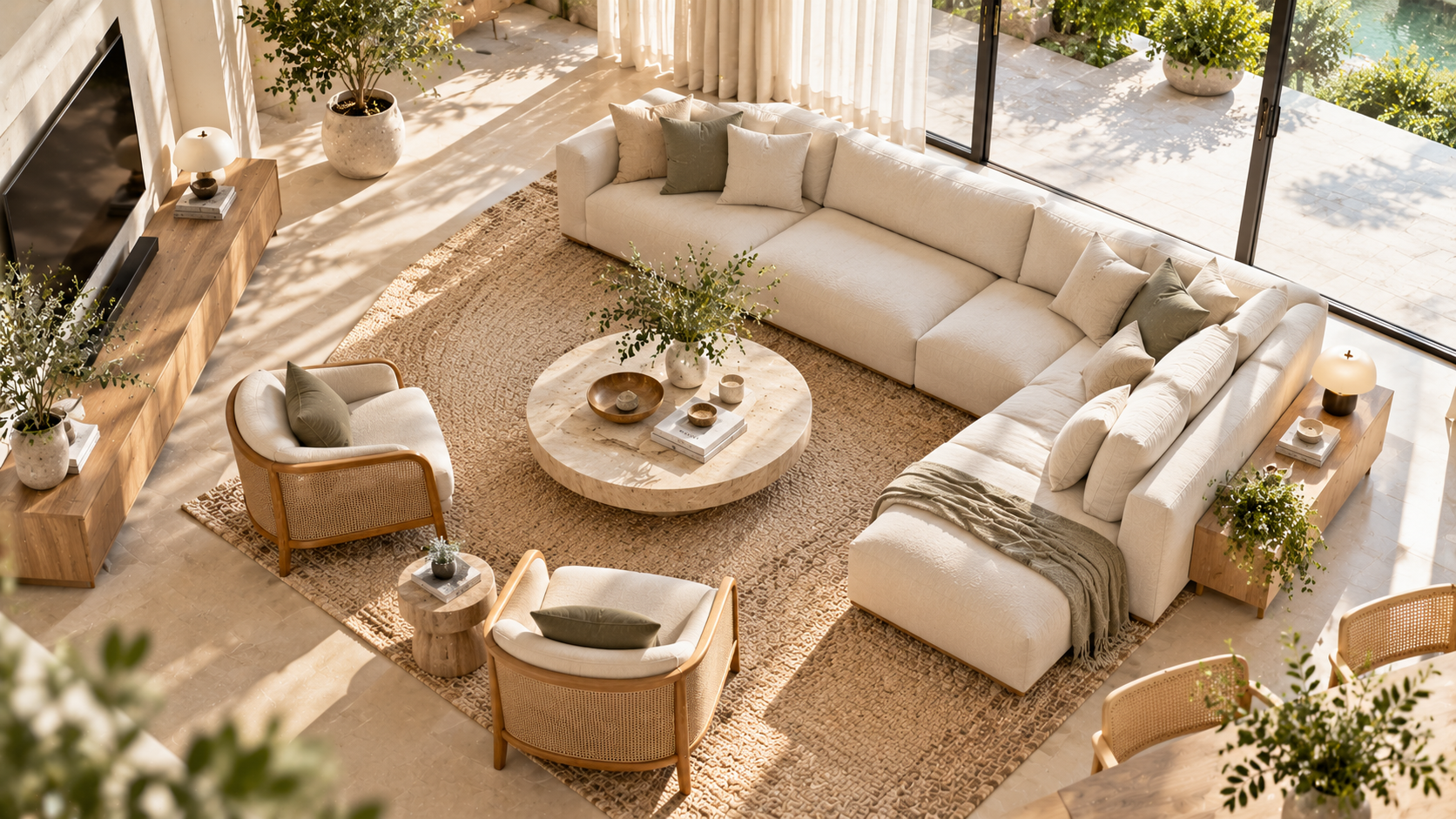
Designing with Neutrals: Contemporary Furniture for Timeless Interiors
A neutral room is often judged by its colour palette. In practice, the more revealing decisions happen elsewhere: how a sofa sits against the floor, where a darker timber interrupts a pale wall, and whether smooth stone is balanced by something softer. Without those relationships, beige, cream and grey can flatten into a single surface. With them, restraint begins to feel deliberate.
This is why contemporary furniture matters so much in a quiet palette. A room with fewer colours asks form, scale and material to carry more of the expression. The curve of an armchair, the grain of a veneer and the depth of a seat become easier to notice. Neutrality is not the absence of character. It is a way of directing attention.
Begin with Temperature, Not a Paint Name
Two pale rooms can feel entirely different. One may lean towards chalk, ash and cool grey. Another may be built from sand, caramel and muted brown. Before choosing furniture, decide whether the base should feel cool, warm or deliberately balanced between the two.
Warm neutrals tend to sit comfortably with timber, leather, antique bronze and cream upholstery. Cooler tones respond well to grey stone, dark metal, smoke-coloured glass and sharper silhouettes. Neither direction is automatically better. The choice should follow the light in the room and the atmosphere the space needs to hold.
Natural daylight can make a colour appear cleaner and more open, while evening lighting may pull yellow or brown undertones forward. Samples should therefore be reviewed beside the intended upholstery, flooring and timber at different times of day. A colour that works on an isolated swatch may behave differently once it meets a full wall or a broad sofa.
Let Materials Create the Contrast
Neutral home decor becomes more convincing when contrast comes through surface rather than added colour. A polished stone top reflects light. Open-grained timber absorbs it. Leather develops a quieter sheen, while woven fabric softens the outline of a large upholstered piece. These differences give the eye somewhere to pause.
The Museum Collection demonstrates how a restrained palette can support several materials at once. Marble, veneer, leather, metal and fabric are not treated as competing statements. Their proportions are controlled so that one material can lead and the others can provide depth.
For a living room, that might mean using a sofa as the broadest tonal field, then introducing a coffee table with stronger veining and a side table with metal detail. In a bedroom, an upholstered bed can establish softness while bedside tables add firmer edges. The aim is not to match every finish. It is to make their differences feel related.
Explore RAVOH's Museum Collection to see how different materials are brought together through considered proportions and refined detailing.
Use Shape to Prevent Visual Flatness
When colour variation is limited, silhouette becomes more important. A room composed entirely of straight-edged furniture can feel severe, even if every surface is pale. Too many rounded pieces can have the opposite effect, leaving the composition without enough definition.
Contemporary furniture design works through this negotiation. A rectilinear sofa can be balanced by a curved armchair. A circular side table can soften the meeting of two larger pieces. A mirror with a rounded frame can continue a curve already present in the seating rather than introducing an unrelated gesture.
RAVOH's Bend Mirror offers a useful example. Its softened outline, veneer and metal frame bring depth without requiring a strong colour contrast. The piece changes the wall through reflection, proportion and material expression. That is the kind of role a supporting object should play in a neutral interior.
Give Every Large Piece Enough Space
Minimalist interiors are sometimes reduced to having fewer objects. The harder part is deciding how much room each object needs. A substantial sofa placed too close to a coffee table can make even a large room feel compressed. A slender console surrounded by empty wall space may appear more intentional than a wider piece crowded by accessories.
Begin with circulation. Mark the paths between entrances, seating and adjoining rooms before settling the furniture arrangement. Then assess the gaps around the principal forms. Negative space is useful only when it clarifies those forms or makes movement easier. Empty corners created by poor placement do not produce the same effect.
Scale also affects tonal balance. A dark piece occupying a small area can anchor a pale room. The same finish across a wall-length unit may dominate it. Contemporary home interiors benefit from looking at colour and scale together rather than treating them as separate choices.
Build a Focal Point Quietly
A neutral room still needs hierarchy. The focal point does not need to be bright or oversized, but it should be identifiable. It may come from a distinctive silhouette, a marble pattern, a deeper material tone or the placement of a piece along the room's longest sightline.
Choose one primary gesture. If the sofa carries the strongest form, keep the coffee table more measured. If a dining table has a sculptural base, allow the chairs to repeat one of its materials without competing with its profile. Several assertive pieces can coexist, but they need enough distance and a clear order.
The RAVOH collection can be read in this way. Sofas, armchairs, tables and storage pieces use recurring materials, but their silhouettes perform different roles. Selecting across categories becomes easier when the question changes from “Do these pieces match?” to “Which piece should lead, and how should the others respond?”
Explore RAVOH's collections to understand how individual furniture pieces can work together while maintaining their own identity.
Allow the Interior to Change with Use
Timeless interior design is not achieved by making a room immune to change. It comes from building a stable composition that can absorb daily life. Books, flowers, objects collected over time and the movement of people will alter the room. The larger decisions should be strong enough to accommodate that variation.
This is where natural materials are especially valuable. Grain, veining and tonal variation prevent surfaces from looking mechanically uniform. They also develop a visual relationship with use. The interior gains character through the way objects are placed, moved and returned, not through a perfectly staged stillness.
The result should feel calm, but not anonymous. In thoughtful contemporary interior design, neutral colours provide continuity while proportion, texture and material establish identity.
For a closer view of how these relationships work across seating, tables and storage, explore RAVOH's collections online or visit the Gurugram showroom to experience the materials, finishes and proportions in person.